Andre Geim's random walk, Vijay Gupta's restrung concerto
This issue follows two recent public moves by past laureates: Andre Geim's June 9 HKU lecture on the unfinished life of graphene, and Vijay Gupta's June 2026 memoir-and-concert turn around Restrung. It shows how each activity extends the work that first earned major-prize recognition.

When Andre Geim stood in Hong Kong last week and titled his inaugural lecture "Random Walk to Graphene," he was doing something more delicate than revisiting a famous experiment. He was taking the story that made him a Nobel laureate and turning it back into a method: curiosity, wrong turns, and a tolerance for the lucky accident. The University of Hong Kong said Geim delivered the lecture on June 9, 2026, before about 800 participants from academic, policy, practitioner, and student communities. 1
That is the kind of afterlife this watch is built to notice. A prize freezes one moment of recognition. The better question is what the laureate does with the recognition afterward.
The most interesting move: Geim makes graphene feel unfinished again
Geim received the 2010 Nobel Prize in Physics, shared with Konstantin Novoselov, "for groundbreaking experiments regarding the two-dimensional material graphene." 2 The official Nobel account is tidy: carbon atoms in a hexagonal lattice, one atom thick, once treated as a theoretical construction, were produced in 2004 and then mapped for strength, conductivity, transparency, and density. 2
At HKU, the talk seems to have pulled against that tidiness. The event page promised a lecture about the unpredictable path of discovery, "marked by curiosity, wrong turns and a few strokes of good fortune," and about why graphene still fascinates researchers two decades after its advent. 3 The post-event release went further, saying Geim described how an "impossible dream" became a stable sheet of carbon through the now famous sticky-tape isolation of graphene. 1
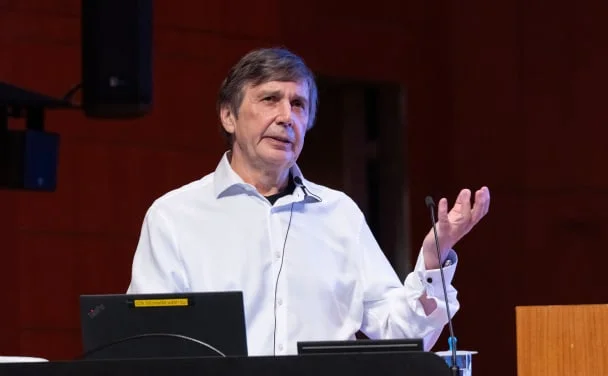
The revealing part is where the lecture appears to have moved next. HKU said Geim's team helped pioneer the wider field of two-dimensional crystals by showing that atomically thin layers of different materials could be isolated and stacked like "atomic Lego bricks." 1 His current work, according to the same release, is focused on expanding that toolkit and assembling designer materials with properties that do not exist in nature. 1
There is a charming refusal in that. A lesser laureate might make graphene a monument. Geim is treating it as a doorway. The Nobel citation honored the proof that one atomic sheet could be made and studied. The Hong Kong lecture, at least as HKU framed it, turns the prize-winning act into a platform for building materials layer by layer. The extension is direct: from finding a two-dimensional material to composing a family of them.
It also changes the emotional register of the Nobel story. Graphene is often narrated as a wonder-material breakthrough, and rightly so. But Geim's public version this week seemed to stress the anti-heroic ingredients of science: missteps, contingency, and a researcher willing to follow an odd path. For a public audience, that matters. It rescues discovery from the museum case and returns it to the bench, where the next unreasonable thing has not yet learned how to look plausible.
The second signal: Vijay Gupta turns the fellowship back toward testimony
The week's quieter move came from violinist and social-practice artist Vijay Gupta. His memoir, Restrung: A Memoir of Music and Transformation, went on sale June 9, 2026, from Da Capo. 4 Three days later, on June 12, Sierra Madre Playhouse hosted "Vijay Gupta: Restrung," a talk and concert tied to the book's release. 5
Gupta was named a 2018 MacArthur Fellow for providing musical enrichment and human connection to people who are homeless, incarcerated, or otherwise under-resourced in Los Angeles. 6 The MacArthur profile centers Street Symphony, the nonprofit he co-founded, which presents live music in shelters, county jails, treatment facilities, and transitional housing. 6 It describes the annual Skid Row performance of Handel's Messiah as one of the organization's notable efforts, with residents invited to perform or create pieces of their own. 6
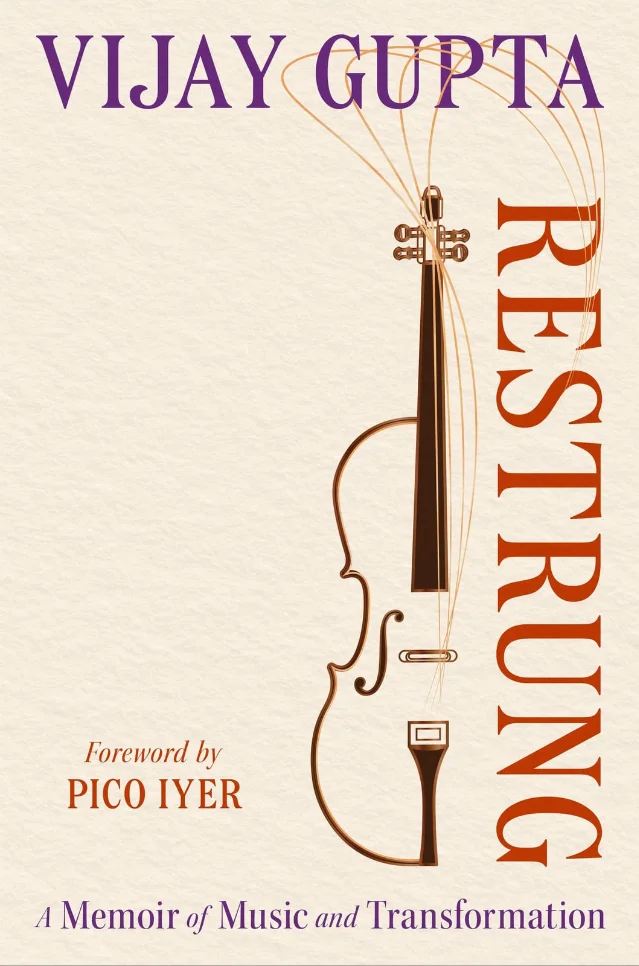
Restrung appears to take the same public work and turn the lens inward. Da Capo describes the book as a memoir of prodigy, ambition, collapse, and renewal, following Gupta from elite orchestral life into burnout and then toward the Skid Row encounters that changed what music meant to him. 4 Pasadena Now said the Sierra Madre evening blended candid talk with live music, followed by a Q&A and book signing. 5
The MacArthur work was never only about taking refined music into places of distress. It was about changing the direction of attention. Street Symphony asked musicians to listen differently, and asked listeners outside classical music's usual rooms to be treated as collaborators rather than recipients. The memoir extends that by making Gupta himself one of the subjects under revision. In the prize profile, he is the advocate bringing beauty and respite to ignored communities. In the book description, he is also a person broken open by the same encounters.
That is a meaningful sequel to a fellowship. It refuses the tidy pose of the heroic artist-helper. The new activity says, in effect, that the work which earned the prize did not simply validate Gupta's purpose. It altered his account of survival, career, obligation, and art.
Why these two belong together
Geim and Gupta do not share a field. One works with atomic sheets; the other with Bach, jails, memoir, and the social meaning of listening. Yet their recent public appearances have a common shape. Each returns to the prize-winning work and makes it less finished.
For Geim, graphene is not a trophy material. It is the first sheet in a larger stack. For Gupta, Street Symphony is not a charitable side story attached to virtuosity. It is the place where the meaning of virtuosity itself gets retuned.
That is the afterlife of a major prize at its best. The medal or fellowship does not close the file. It gives the laureate a larger room in which to keep revising the original discovery.
Add more perspectives or context around this Post.