Synthesia's growth playbook: $100M ARR, 90% of Fortune 100, and the training wedge inside AI video
How Synthesia turned AI video from a demo surface into an enterprise training workflow: self-serve acquisition, content-system retention, and credit-plus-enterprise monetization.

Synthesia is easiest to misread as an AI video generator. The growth story is narrower and stronger: it sells a cheaper way for enterprises to turn training, support, compliance, and enablement material into localized video libraries.
The numbers explain why that wedge matters. Synthesia announced a $200 million Series E at a $4 billion valuation in January 2026, and said it was used by over 90% of the Fortune 100. 1 Nine months earlier, the company said it had passed $100 million in ARR, with over 65,000 businesses and more than 70% of the Fortune 100 as customers. 2
| Growth layer | Mechanism | Why it works |
|---|---|---|
| Acquisition | A free Basic plan, $29 Starter plan, $89 Creator plan, and custom Enterprise tier make the product buyable before procurement gets involved. 3 | The user can prove the output first, then sell the workflow internally. |
| Retention | Workspaces, brand kits, personal avatars, translations, SCORM export, collaboration, and enterprise controls sit inside the same production system. 3 | Leaving means recreating more than videos: templates, actors, translations, review habits, and training workflows move too. |
| Monetization | Self-serve plans are capped by credits and minutes; Enterprise moves to custom credits, unlimited minutes, onboarding, SSO, CSM, and implementation services. 3 | Usage expands from a creator seat into a department-wide content operation. |

Acquisition: sell the pain, not the avatar
Synthesia's acquisition motion starts with a boring enterprise problem: video is expensive to produce, slow to update, and painful to translate. That framing lets the company avoid competing only on model quality. The visible hook is an avatar. The budget owner is buying speed, localization, and consistency.
The customer-story page makes this unusually explicit. It lists SAP at 70% faster internal video asset creation, Moody's at an 87% reduction in video production time, Heineken at 70,000 employees trained worldwide, and Mondelez at 100 hours of localization work done in 10 minutes. 4 Those are not generic AI productivity claims. They map to line items L&D, sales enablement, support, and internal communications leaders already track.
The second acquisition choice is price architecture. Basic is free and includes 1,200 credits per month, usable for up to 10 minutes of video. Starter is $29 per month, Creator is $89 per month, and Enterprise is custom. 3 That creates a clean bottom-up path: a training manager can make a real artifact without asking legal or procurement to bless an enterprise AI platform on day one.
Retention: the switching cost is the content system
The sticky part of Synthesia is not that a user likes one generated clip. It is that the organization starts treating Synthesia as the system of record for video-based knowledge.
Teleperformance is the cleanest example. Its L&D team says Synthesia saves an average of five days per video and up to $5,000 per video versus traditional video creation, while helping standardize learning content across more than 170 countries. 5 Once a company trains teams in dozens of markets with one tool, switching vendors means reopening templates, translations, approvals, and brand standards.
Berlitz shows the same pattern on volume. It used Synthesia to create more than 1,700 micro-videos in six weeks, cut production time by 70%, reduced production costs by 66%, and moved the team from six full-time people to two. 6 Electrolux adds the localization angle: it deployed more than 40 video modules, localized training into 35 languages, and says a complete training video can now be produced in about two hours before review and publication. 7
Avetta turns retention from a creator workflow into an operating metric. It reports a 20% faster ramp-to-proficiency for new support agents, an 8% increase in agent retention, a 16-second decrease in average call handling time, and 1,300 hours saved over two years. 8 That is the retention loop: more content creates more internal dependence; more dependence creates more teams asking for access.
Monetization: credits below, services above
Synthesia's monetization is a two-level machine. At the bottom, it uses self-serve credits. Every second of generated video costs 2 credits, so a one-minute video consumes 120 credits. Starter and Basic include 1,200 credits per month; Creator includes 3,600 credits per month. 9 The same credit pool extends across AI dubbing, bulk personalization, API usage, custom video assets, and AI image generation. 9
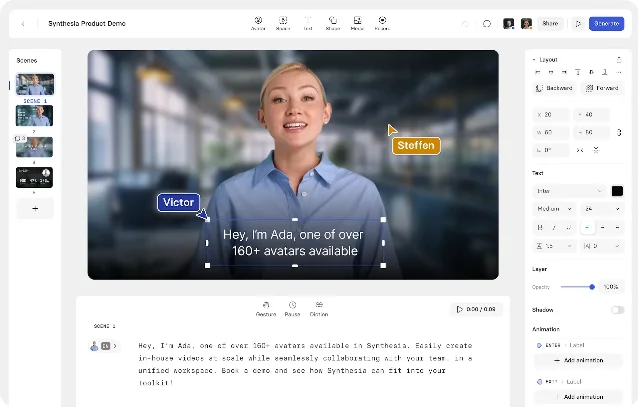
At the top, Enterprise strips out the small-plan ceiling. It adds unlimited video minutes, 1-click translations into 80+ languages, 240+ stock avatars, unlimited personal avatars subject to reasonable consumption, SAML/SSO, live collaboration, brand kits, SCORM export, implementation services, and a dedicated customer success manager. 3 That is where the expansion revenue sits: not in charging a hobbyist for a better avatar, but in letting a global company standardize training video production.
The unresolved data gap is net retention. Synthesia discloses ARR, customer count, Fortune 100 penetration, and pricing mechanics, but it has not publicly disclosed enterprise ACV, gross retention, or NRR. The case-study evidence points to strong expansion potential, but those operating metrics are still private.
Transferable takeaways
- Pick a painful production workflow before selling the AI surface. Synthesia sells video cost, speed, and localization; avatars are the visible interface.
- Use customer proof as acquisition material. The strongest case studies quantify time saved, cost saved, and operational outcomes, not vague satisfaction.
- Build switching costs around assets and process. Templates, brand kits, translations, custom avatars, approvals, and LMS exports are harder to replace than a model demo.
- Let self-serve prove the artifact, then monetize the department. The free-to-Creator ladder creates evidence; Enterprise captures governance, scale, and rollout support.
References
- 1Synthesia raises $200 million Series E at $4 billion valuation to change how companies train and upskill their workforce
- 2Synthesia surpasses $100 million in annual recurring revenue and secures strategic investment from Adobe Ventures
- 3Synthesia Pricing - Compare Free and Paid Plans
- 4Case Studies: See how AI videos can save you time & money
- 5How Teleperformance is training a global workforce
- 6How Berlitz creates language training videos 70% faster
- 7How Electrolux trains 15,000 customers, partners & employees in 30+ languages
- 8How Avetta is using AI video to boost the productivity of 150 support agents
- 9Self-serve users guide to credits
Add more perspectives or context around this Post.